Consultations sur les langues officielles 2012 : Perspectives d’avenir

Alphabet langue françaiseEn mai 2012, le ministre du Patrimoine canadien et des Langues officielles a lancé une série de consultations pancanadiennes sur les langues officielles menées par le gouvernement du Canada. Les Canadiennes et les Canadiens sont invités à identifier les défis et priorités actuelles liés aux langues officielles et à la dualité linguistique et auxquels le gouvernement devrait consacrer ses efforts au cours des prochaines années.

Vous pouvez remplir le Questionnaire en ligne ici: http://www.pch.gc.ca/fra/1337699948163

Voici quelques extraits des commentaires que j’ai partagé via le questionnaire:

– Des ressources remises aux organismes provinciaux/territoriaux ainsi qu’aux organismes locaux assureraient d’avoir un impact direct sur les Canadiennes et les Canadiens. Ceci inclut des ressources investies en services aux familles et aux enfants, aux étudiantes et aux étudiants, aux entrepreneures et entrepreneurs, aux personnes âgées et aux immigrantes et immigrants. L’impact le plus direct est important, mais il faut aussi s’assurer d’avoir un impact durable.

– Les services pour les familles, pour les enfants, pour les adolescents, pour les nouveaux arrivants, en français, sont cruciaux! Ce n’est pas suffisant que d’avoir droit aux services, il faut qu’ils soient accessibles et de bonne qualité, sinon, nous ne sommes plus que des citoyennes et citoyens de deuxième classe.

– Les francophones naviguent, discutent, gazouillent en français. Il serait important de soutenir la présence et l’espace francophone sur Internet, qui est et doit être, de nos jours, bien plus que quelques pages web bilingues.

– Si le gouvernement tient à livrer des programmes de qualité à ses communautés en situation minoritaire, comme il le devrait, il s’agit de donner les ressources nécessaires aux communautés pour leur épanouissement. Cela commence par un financement adéquat et dans les délais aux organismes communautaires, bien sûr, et s’accentue par un appui moral, politique et bureaucratique de la part du gouvernement auprès de ces organismes et des communautés qu’ils servent.

Certification en création littéraire

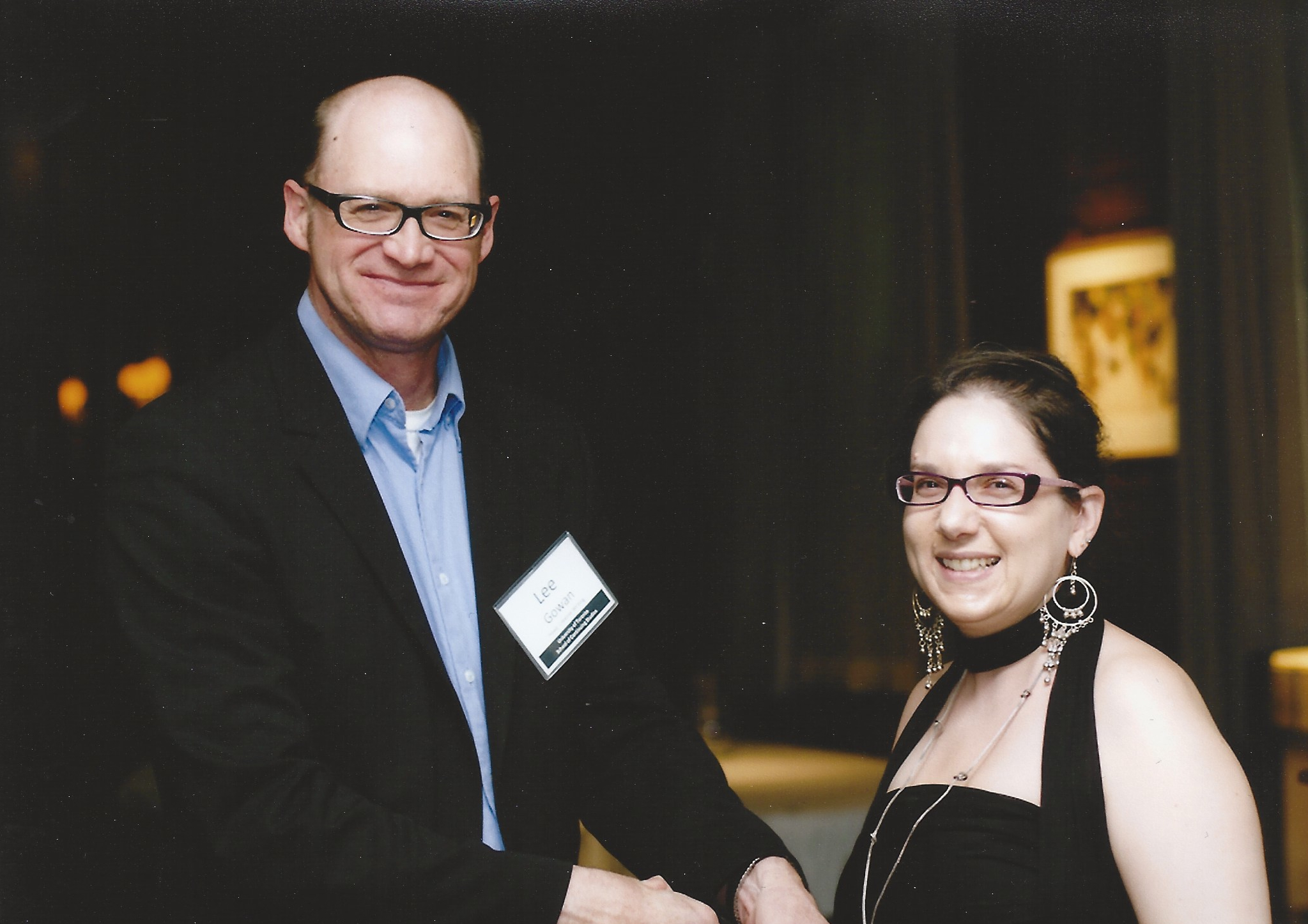
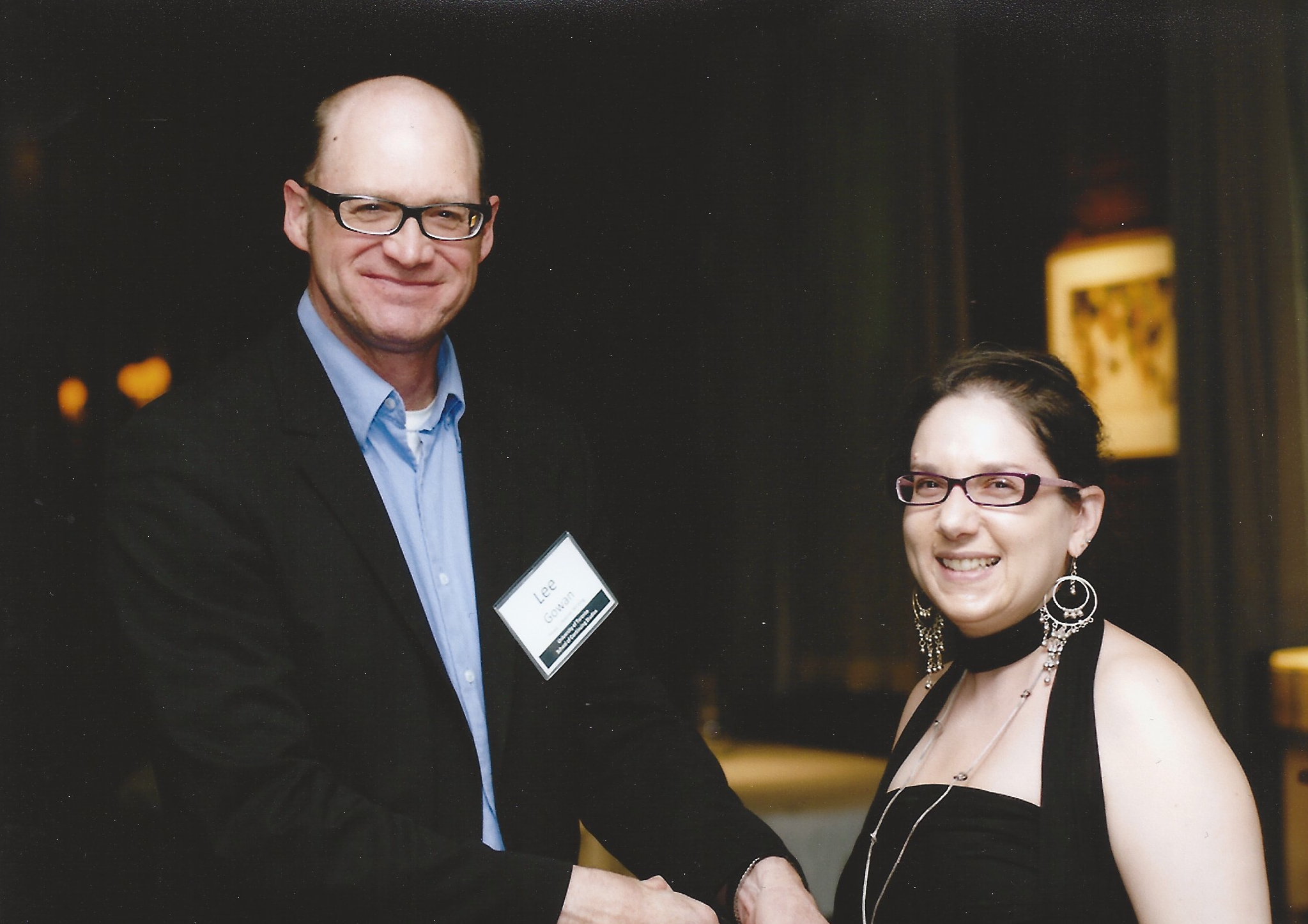
A.M. Matte et Lee Gowan, Chef du programme de création littéraire de l'Université de Toronto

Je ne sais pas si c’est parce que c’est ma graduation la plus récente ou parce que c’était mon parcours scolaire le plus amusant, mais j’ai un peu l’impression que je suis plus fière de ma certification en création littéraire (Université de Toronto) que de mon baccalauréat en journalisme, science politique et études africaines (Université Carleton) et de ma maîtrise en communications (Université d’Ottawa) – dont je suis déjà très, très fière. (Peut-être parce qu’en même temps j’ai donné naissance et élevé un poupon?)

Je remercie mes profs et mes collègues de classe qui ont contribué à ma réussite, en particulier ma mentor, la dramaturge Colleen Murphy, qui m’a conseillée et guidée lors de l’écriture de mon projet final, ma pièce de théâtre Seven Dragon Happy-Go-Lucky Golden Garden House of Foo(d).

U of T Creative Writing Certificate

A.M. Matte with Lee Gowan, Head of the Creative Writing Program at the University of Toronto

It may be that I’m the teeniest bit more proud of my Creative Writing Certificate (University of Toronto) than of my Bachelor of Journalism, Political Science and African Studies (Carleton University) and my Masters in Communications (University of Ottawa) – both of which I’m extremely proud. It might be something to do with having had a baby at the same time as I was completing the certificate; it might be something to do with how much fun I had getting ‘certified’ in something I enjoy so much.

Many thanks to the creative writing teachers and fellow students who helped me polish my craft; special thanks to Colleen Murphy, my playwriting mentor, who guided me in creating a better script. Next up, the stage!

An intimate reading

Fallis-class reading
A.M. Matte reading "A Treat"

I’ve heard it asked before: What if you plan a reading and no one shows up?

The answer: It’s not the quantity of people who attend, it’s the quality.

I had the opportunity to read my short story « A Treat », about a young girl who desperately wants her older sister’s approval and is willing to do anything – even buy her an ice cream treat – to get it, in Terry Fallis’ Building An Audience For Your Writing class at U of T this week.

There were only three other people in the room, but they gave me their rapt attention and insightful feedback on my writing and my performance. They asked probing questions about my characters’ motivation and gave me tips on how I can make reading excerpts of the written word more compelling.

The best thing about a small yet captivated audience?  You can read more material. Case in point: we had such a great time at our reading that we’re doing it again next week.


Le grand Michel Tremblay

Ce n’est pas à tous les jours que l’on a la chance de rencontrer son idole en personne. Alors le jour où j’ai entendu Michel Tremblay lire un extrait de La traversée du continent et discuté avec lui un moment (le temps qu’il autographie les trois livres que j’avais avec moi), j’ai été comblée.

Michel Tremblay autographie un de ses romans
Michel Tremblay à la bibliothèque de Toronto

L’oeuvre de Michel Tremblay est incontournable* et inspirante. C’est un talent particulier qui décrit, à lui seul, une ère. Les Canadiens français – le monde entier, même – doivent une fière chandelle au chroniqueur de la vie des Nana, des Albertine, des Pierrette, des Paul, qui, sans lui, n’auraient jamais eu leur voix, leurs mots, résonner aux quatre coins du globe.


* J’ai même joué le rôle d’Olivine Dubuc, la vieille dame de 93 ans en chaise roulante dans Les belles-soeurs, au secondaire. Elle n’a que six répliques, mais sans sa dernière, la pièce ne peut terminer…


Backlink hunters

« I like this web blog it’s a masterpiece! Glad I discovered this on google. »

« I don’t even know how I ended up here, but I thought this post was good. You are going to [be) a famous blogger if you aren’t already 😉 Cheers! »

« Wow, awesome blog layout! How long have you been blogging for? you made blogging look easy. The overall look of your website is excellent, let alone the content! »

« Beautiful! There seems to be no end to your talent! I hope we get to see more of your work–perhaps for sale at some point? Thanks for sharing your creativity with the world. »

Thanks, very flattering!

Too bad these are fake comments made by backlink hunters. Nothing better than compliments to trick people. Here’s to hoping that one day the positive comments are real!

Chasseurs de liens retour (backlinks)

« Ce site web est franchement utile, et fascinant. Il m’a indubitablement été utile. Je souhaite que ce site puisse donner tant aux autres lecteurs qu’à ma personne. Félicitations. »

« Salut, j’ai consulté votre forum et j’ai découvert des sujets palpitants. J’espère que vous me laisserez faire suivre certaines de vos idées pour parfaire mon site internet. Je vais donner votre adresse auprès de mes connaissances et je suis sur que vous aurez énormément de visites. »

« Écrits très informatifs; continuez! »

Merci, c’est très flatteur!

Dommage que ce soit de faux commentaires fabriqués par des chasseurs de liens retour. Rien de mieux que des compliments pour arnaquer! Reste à souhaiter qu’un jour les commentaires positifs seront véritables.

Effortlessly Inspiring

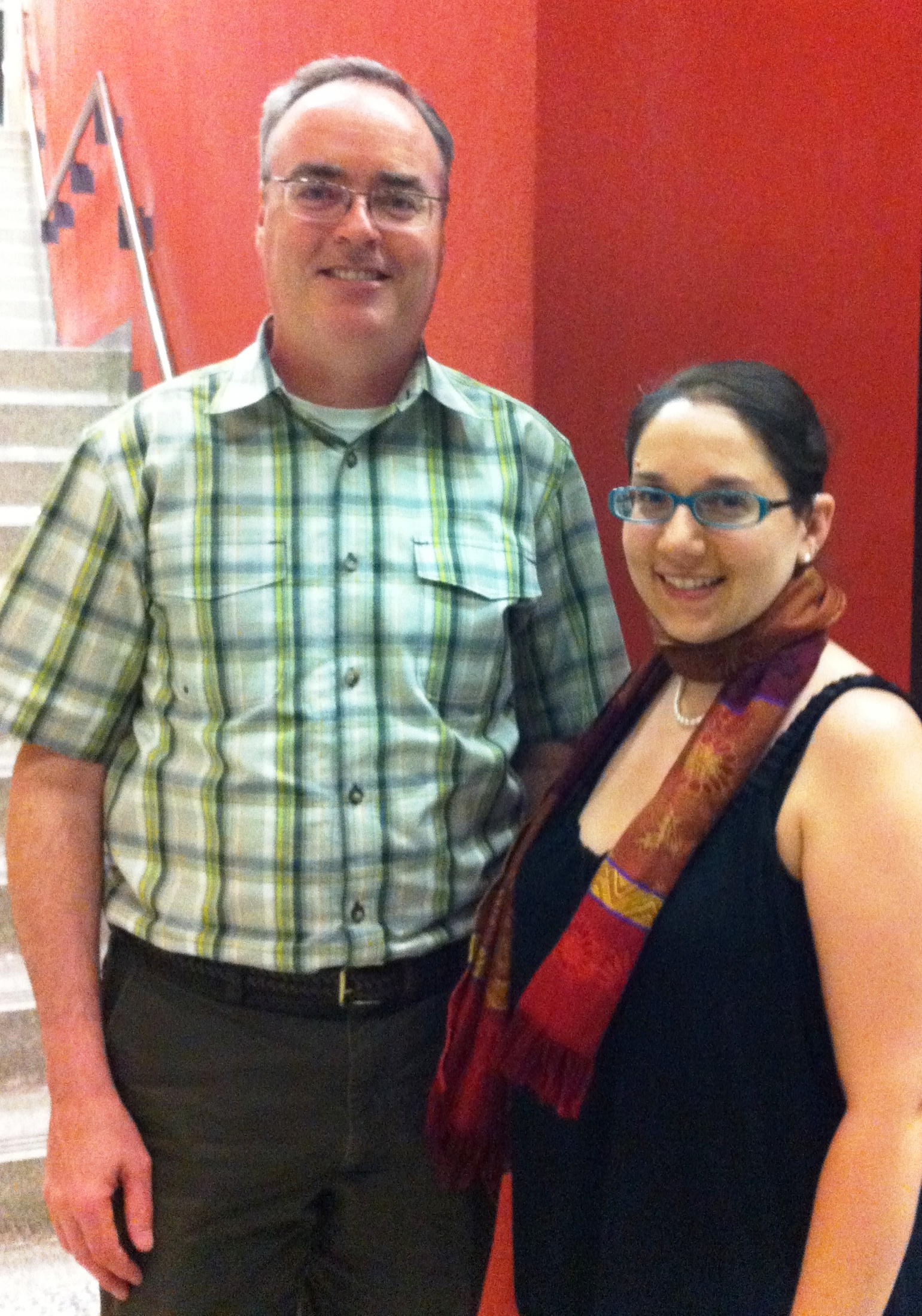
Terry Fallis and A.M. Matte at the University of Toronto

You know what it’s like when you wait a long time to meet a celebrity / favorite artist and you’re disappointed once you’ve met them?

I don’t.

Because while I waited a year to meet Terry Fallis, award-winning author of The Best Laid Plans, The High Road and the much-anticipated September 2012 release Up and Down, he managed to exceed my lofty expectations of him.

Fallis, who is teaching a U of T continuing studies class on Building an Audience – marketing for writers, is as genuine and as funny as I’d imagined him to be. He is knowledgeable and self-deprecating, and he picked up on my fandom immediately. I didn’t even have to ask him to sign my copies of the aforementioned novels, he offered.

For five weeks, Fallis will school a small group of writers in various marketing methods, including optimizing social media, self-publishing and podcasting, and mastering the art of the reading. He gleans his material from his PR experience as well as from practical examples from his own progression as an esteemed Canadian author. We were so taken with the first class that we stayed past the end time, discussing authors’ web presence and blogs. I love when learning is effortless and inspiring.

And lest this post seem like an attempt to butter up a prof for a good grade, let it be known that I’ve already finished my Creative Writing Certificate; this course is just candy. But should Fallis hand out grades, I expect to earn an A.


Prix de reconnaissance communautaire

A.M. Matte et statuette (Pascal Demonsand) de Théâtre Action
A.M. Matte et le Prix de reconnaissance communautaire

En juin 2011, j’ai eu l’honneur de participer à la soirée gala de remise des Prix de reconnaissance de Théâtre Action. J’y étais en tant que membre du collectif d’auteurs de la pièce Communicata 2010, qui se voulait un regard humoristique sur la question des registres et des accents du français.

Jouée à guichets fermés par les Indisciplinés de Toronto, Communicata 2010 était la culmination de plusieurs mois de travail intense par une cinquantaine de personnes. C’est pourquoi l’effort collectif de ces «indisciplinés» a été reconnu par Théâtre Action, «pour l’originalité de leur démarche artistique, leur audace, le caractère rassembleur, l’impact sur leur communauté et surtout pour la qualité de leur travail.»

Nous étions quatre à représenter le collectif lors du gala, mais avons fêté comme si nous étions cinquante. C’étaient nos Oscars (c) à nous.

Maman’s Hands

Bottles of hand lotion are strewn throughout my mother’s house. An Ahava squeeze bottle next to the telephone in the kitchen, aloe vera crème on her nightstand, dollar store lotion in the powder room, a myriad of minuscule hotel-brand bottles of lotion by the remote control in the living room, by her computer keyboard, in her car and in her purse.

Maman’s hands have always been smooth and soft, despite her habit of picking at the skin around her nails until it bleeds – a habit I inherited. She has dainty fingers that used to play flute and piano and which now spend a fair amount of their time clacking away at her computer keyboard, exchanging jokes and news with family and friends around the globe from her post in Ottawa, where I grew up with my brother.

When we were young, Maman would cup our faces in her hands to give us kisses and she would stroke our backs when we felt ill. She always had a hug ready for us when she came back home after work and, of course, held our hands when we crossed the street. To this day, we link arms when strolling up a street or perusing a mall.

My brother now lives in Sudbury and I live in Toronto, far from our mother’s eager embrace. She doesn’t see us as often as she’d like, despite our Skype conversations, and she certainly doesn’t get to hug us as often as she’d like. Not one to dwell on her empty nest, Maman turned to hobbies that she’d set aside while raising her family. She acquired a loom and learned to weave; she picked up an extra sewing machine to perfect her skills; and she took up quilting, her nimble fingers creating works of art from discarded bits of fabric.

Very family oriented, my mother buried the fact that she wanted grand-children. Neither my brother nor I had shown any interest in ever having children; I, particularly, had voiced my convinced opinion that I was not made for a) a long, steady relationship and/or b) motherhood.

When I met and then married Jason, however, my mother’s hopes for a grand-child resurfaced. Yet she was subtler than most. While nearly everyone was quick to ask Jason and me: “So, when are you getting married?” and, once married, insisted to find out: “So, when are you having children?” – Maman didn’t want to push us. She made us a gorgeous emerald green and blue-black travelling-diamond-patterned quilt for our bed and simply hinted that she looked forward to making a smaller one “when the time comes”.

While she waited, Maman began a sewing circle of women making baby quilts for children in Israel, and continued to create quilts for her friends’ and relatives’ grand-children, each more intricate than the next. She said she was practicing for when she’d finally get to make a quilt for her own grand-child.

When my son Rohan was born in January, Maman was the first non-medical visitor who held him in her arms. She cradled his small body in the nook of her arm, stroked his cheek with her soft fingers and covered him in gentle kisses. And when came the time to bring him home from the hospital, she was ready. Out of her bag came the creation she’d been working on since we announced I was pregnant: a red-blue-green-yellow square-patterned zoo animals quilt, in which she wrapped Rohan to protect him from the cold.

She also took out of her bag a small bottle of lotion and handed it to me, so that I will always have soft hands when cuddling my son.